
Aaron Robles is a Mexican American entrepreneur and community advocate focused on building businesses, leaders, and systems that strengthen underserved communities. Through storytelling, mentorship, and hands-on leadership, he works to connect people to opportunity and turn shared knowledge into lasting impact.
We live in a world that seems to be changing faster and faster each day. Technology is getting smaller, more capable and increasingly mandatory in our lives. It seems as if AI is inescapable, popping up as a feature in just about every piece of software that’s widely used.
Despite all of this, in many ways the evolution of education seems to have fallen behind. The way we approach education in this country has rested on the same foundation, despite a world that is quickly evolving. But more and more, we’re seeing cracks in that foundation to a new way of approaching education.
When I was in high school, one of the most life-altering experiences I had was attending the Anthis Career Center in Fort Wayne, Indiana. A vocational school that I attended half days (the other half at my traditional high school), Anthis had a completely different way of teaching. There were a variety of programs from nursing and early child care to automotive, construction trades, and graphic design, where I ultimately landed.
Prior to having DACA status, in high school I was undocumented. Although I had been in the United States since I was 8 months old, I came to learn that I was different the older I became. I wasn’t able to get a job or drive a car like my peers, which made fitting in increasingly difficult. Anthis gave me, at the tender age of 16, a valuable skill that gave me a pathway to growth.
It started my journey of entrepreneurship that would become a defining part of my life. While I was at Anthis, I learned how to become a graphic designer, as well as learned the business side of it. We worked with real businesses in the community and got to see our work in the wild, not just within the four walls of our classroom. Anthis provided me with a way to generate income when I didn’t have another way to do it. I’m grateful to say that now in my 35 years on this earth, I’ve been in my profession for over half my life. I have a growing agency where I can make a real impact within my community. However, beyond that, Anthis gave me purpose when I had none.
When we visited Purdue Polytechnic High School, I instantly connected to what my days at Anthis were like. The intentionally that it is designed with showed. In an age where schools are drastically underfunded and resources are scarce, it can be hard to meet expectations, let alone excel and be innovative. However, as the staff shared with us all the things they were working on, it became obvious how precise and intentional they were on what they were building.
They talked about how they had begun growing their own food in a garden and how it was a group of students who had actually presented the idea. Their work with partner businesses that gave students an opportunity to experience real-world companies doing real work. We even got to do group projects with the students by our side. It was easy to see that this school was different and the students who attended wanted to be there.
This level of engagement wasn’t happening because of an extraordinary budget or perks they got. It was because much like I had experienced when I was younger, they are connecting each student with a sense of purpose. They’re allowing the students to see, hear, and touch when they learn. They’re having them take ownership and be accountable for what they do and don’t do. Skills that are integral to life later down the line.
Not to mention, their partnership with Purdue University closes the gap between high school and college, ensuring that the students there have a clear and seamless transition as they approach their next chapter. Something that can be a huge barrier to many. Regardless of how many great opportunities we put in front of them, however, none of it will matter if the students themselves don’t have an internal motivation to take advantage of them.
The sense of purpose and self responsibility they are given from an early age shapes them into future members of society that value the very same core values that MDLF believes in.
As adults, we talk about purpose a lot. We want to be fulfilled at work, do good work that matters and makes the lives of others better. Why is it that we think that younger generations don’t have that same desire? The most engaged students I’ve seen are those who know why they’re doing what they’re doing. They know there is a means to an end.
PPHS is an experiment on what is possible in education, and while we have yet to find the perfect solution, innovations in how we approach education, especially at an early age, is critical. It’s a necessary and long overdue evolution of how education can look for the next generations so that they can keep pace with an ever demanding world.
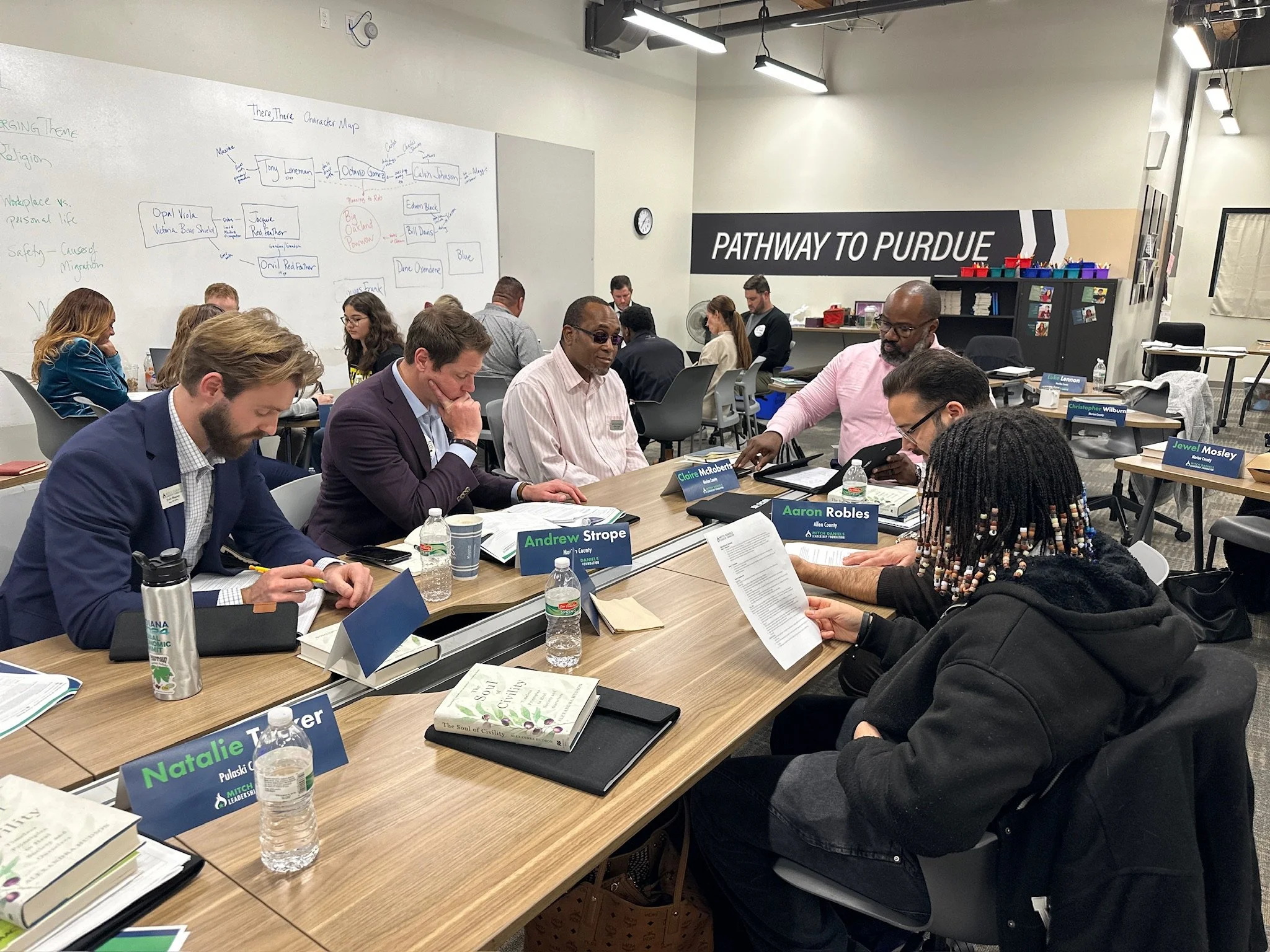
Class VIII Fellows at Purdue Polytechnic High School - Englewood working on a case study prompt project with students.