
Restoring Balance to the Force: Free Speech, Civility, and the Blind Spots We Choose
Zach Finn is a Senior Risk Management Consultant in the Risk Services Division at HUB International, advising manufacturing, food & beverage, and education organizations on complex risk and crisis management issues. He is the former Director of the Davey Risk Management & Insurance Program at Butler University, which he helped co-found, and gained national visibility during the pandemic for his work on pandemic risk and business interruption.
It’s hard to be a moderate in this country, but it has always made sense to me. Maybe it’s my risk manager’s brain. I try not to see the world in left-versus-right terms, but in terms of risks, opportunities, and unintended consequences. During the pandemic, I wrote about the tension between risk and opportunity: choke out all risk, and you choke out opportunity; create unlimited opportunity, particularly with technologies like artificial intelligence, and you generate unknown risks. Everything exists in balance.
That same tension now defines the relationship between free speech and civility. Free speech without civility produces chaos. Civility without free speech produces compliance. The country feels unstable because we have lost the balancing mechanism between the two.
That is why I became an MDLF Fellow. I wanted to join a cohort where ideas can be challenged without people being diminished, where disagreement is not war, and where leadership is modeled rather than performed.
This month, I had two opportunities for civic engagement through my participation in the MDLF Program:
A media-focused Aiming Higher event on trust and narrative
An MDLF Fellowship Day on civil society and free speech
Both events delivered the same unmistakable message:
We don’t have a civility problem because people have changed.
We have a civility problem because the venues of our engagement have changed.
The Online World vs. The Real One
In the real world, people with wildly different political beliefs still attend the same kids’ soccer games, serve on the same nonprofit boards, work in the same offices, attend the same Colts games, and have civil conversations.
Online, every disagreement feels like an existential threat. We use “national” information to interpret “local” interactions, and in the process, poison the very soil we live on.
At the Aiming Higher media event, this theme rang loudly through speakers like DuJuan McCoy, Owner and CEO of Circle City Broadcasting and Oseye Boyd, Editor-in-Chief of Mirror Indy. DuJuan emphasized that when broadcasters become content factories rather than civic anchors, the public senses it immediately, and accountability matters. Oseye spoke about communities who feel unseen and how when local storytelling evaporates, identity gets outsourced to the loudest national caricatures.
We say “shop local,” “eat local,” and “support local,” but we never say, “inform local.” We treat dinner and bourbon with more discernment than our information diets. Small wonder the nation feels unwell.
What Happens When People Actually Talk
At the MDLF Fellowship Day at Purdue University, speakers from law, media, and higher education reinforced the same theme from different angles. Justice Geoffrey Slaughter reminded us that the First Amendment sets the minimum standard for a free society, not its highest aspiration. Alexandra Hudson reframed civility not as politeness, but as the operating system that allows free speech to function at all. Pete Seat explained why narratives increasingly outrun facts in fractured media ecosystems, while Dr. John Gates grounded the discussion in the human stakes of inclusion, emphasizing it as foundational to innovation and institutional excellence.
But it was Dr. Sue Ellspermann, former President of Ivy Tech and former Lieutenant Governor of Indiana, who delivered the day’s moral center.
She spoke candidly about her role in the RFRA era, the 2015 Religious Freedom Restoration Act, which became a statewide reputational crisis when it was nationally perceived as enabling discrimination.
Dr. Ellspermann didn’t deflect responsibility or blame the press. She expressed regret and a sentiment I haven’t heard a political leader convey in years: We got it wrong.
She had already proposed something simple and brilliant during her term: to seat the Indiana General Assembly like normal human beings, Republican, Democrat, Republican, Democrat. Because when people only listen to their own, they develop blind spots.
Preventing a New Blind Spot: Eliminating the Opponent
If the RFRA fallout came from not sitting next to your opponents, then the recent push for mid-decade redistricting, designed to eliminate political opponents entirely, doubled down on the same mistake.
Redistricting designed to eliminate competition narrows perspective, removes friction, and replaces accountability with certainty.
When I first began writing this article, the redistricting debate was still active in the General Assembly. Since then, the Indiana Senate has rejected the effort. That outcome matters, not because one side “won,” but because a lesson appears to have landed.
Dr. Ellspermann demonstrated real political courage in this debate. She said plainly, publicly, in print, and before the legislature, that mid-decade redistricting serves partisans, not Hoosiers. She took the hard-earned lessons of RFRA seriously and spoke up to prevent Indiana from walking into a new, self-inflicted blind spot.
I can’t imagine many people eager to reenter public life when disagreement now carries the risk of online caricature and personal attack. And yet, Dr. Ellspermann chose principle over comfort, balance over advantage, and long-term civic health over short-term partisan gain.
If we want to restore civility, the path forward isn’t abstract. Source information and engage locally before reacting nationally. Treat political opponents as necessary guardrails, not existential threats.
Before these two MDLF events, I could not see a path to restoring civility. Then I witnessed Sue Ellspermann’s courage, saw the Senate put a stop to the redistricting effort, and, while writing this, read the following Politico headline: “Indiana GOP’s Trump rebuke could lead to temporary redistricting détente.”
It turns out Hoosier Hospitality and pragmatism can still defeat politics. I suspect if the General Assembly had mixed political seating, they might also discover a shared love of pork tenderloin sandwiches, that we’re all rooting for the Colts’ grandpa quarterback, and that civility is alive and well in the real world.
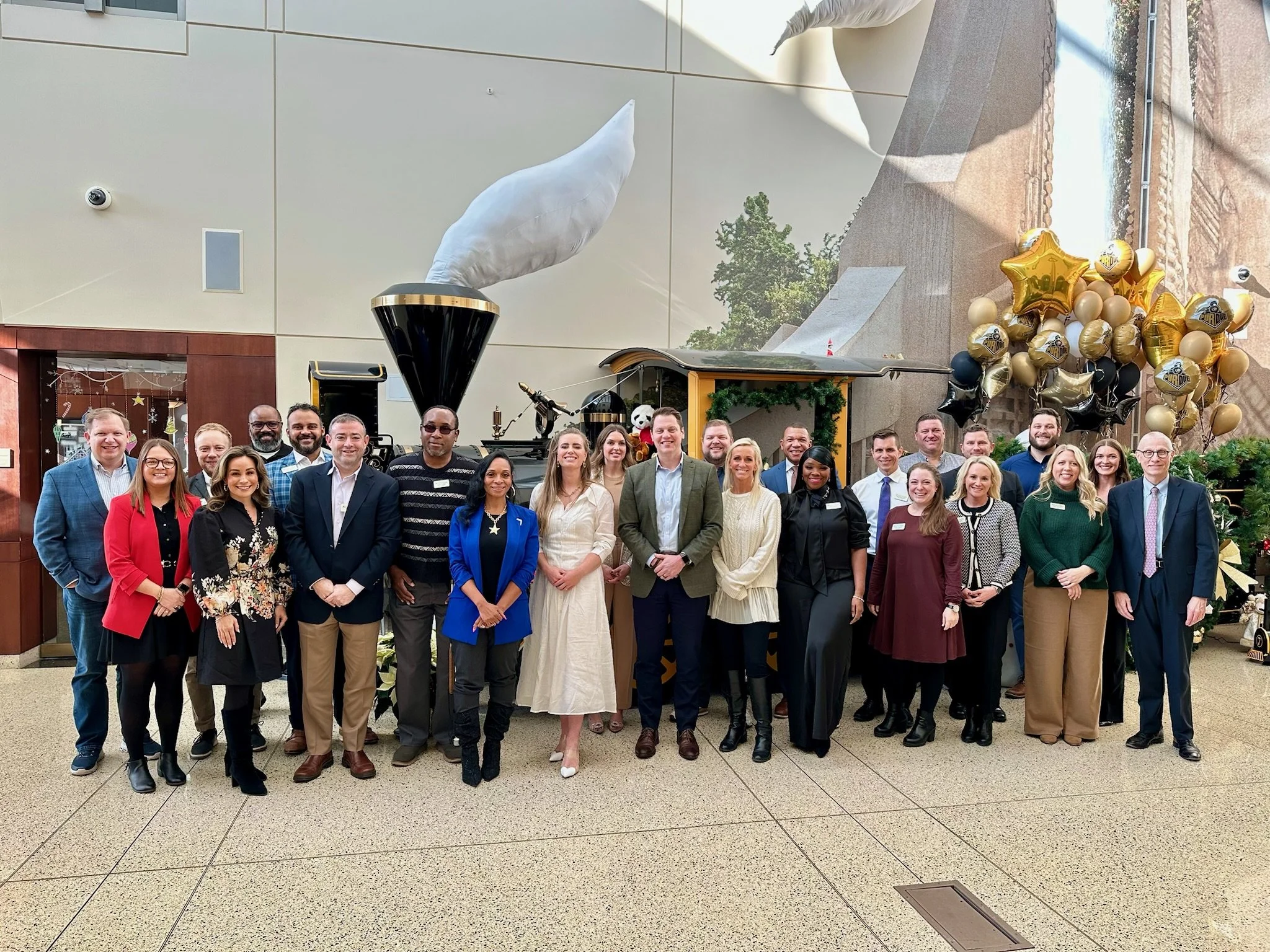
Fellowship Class VIII at Purdue University