
Scott Massey, founder & CEO of anu™, is a former Purdue NASA research engineer in hydroponic LED systems for future space habitats. He invented AI-powered indoor cultivation technologies backed by the NSF and USDA, recognized by Forbes 30 Under 30 for empowering communities to achieve sustainable nutritional sovereignty. Massey has led four U.S. State Department advisory tours across Africa for the Mandela Washington Fellowship, promoting STEM and hydroponic entrepreneurship to combat terrorism and human trafficking recruitment.
Driving from my home in Evansville to Columbus on I-69 for the MDLF Fellowship at Cummins’ state-of-the-art battery and engine R&D center, I reflected on Major Moves—Governor Daniels’s 2005 infrastructure initiative. By leasing the Indiana Toll Road for $3.85 billion before the Great Recession, Indiana secured capital unlikely to arrive for another decade—what Ryan Kitchell, former state budget director, called the perfect convergence of professional advisors, a pedal-to-the-metal mindset, and political courage. I was traveling the interstate born of that policy—one that turned what once took two days and an overnight stay into a single-day trip.
Inspired by No Impact Man—a pragmatic sustainability book recommended by then–Purdue Pres. Mitch Daniels to our 2013 freshman class—I worked on NASA-funded hydroponic-LED space farming research at Purdue and later developed an indoor growing system to boost yield, efficiency, and usability. These innovations led to founding anu™ and securing early venture funding from Purdue’s Agcelerator Fund, established under Daniels’s leadership. Routine access to Indianapolis—made possible by Major Moves infrastructure and the economic development state venture capital it enabled—was essential for securing investment, building partnerships, and connecting state/federal resources to expand globally. This accessibility now supports controlled-environment agriculture expanding access to fresh, nutritious produce statewide. As the seedling given to me at age 13 by then-Governor Daniels at an Evansville I-69 rally grew, so did the vision it symbolized—maturing into the very infrastructure now delivering measurable gains in cost savings, safety, and sustainability for nearly half a million residents of Southwest Indiana. To understand the real-world impact behind that symbolism, I set out to quantify the benefits of I-69’s completion compared to the old route.
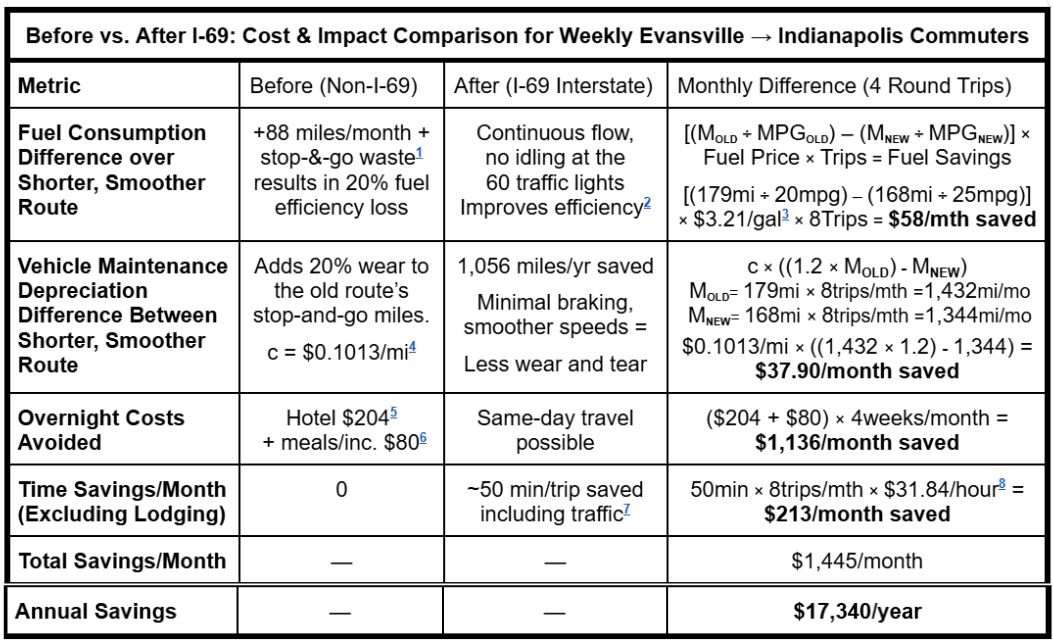
Today, the I-69 corridor he championed delivers those opportunities in measurable ways. Weekly Southern Indiana commuters like me save an estimated $17,340 annually in travel costs to Indianapolis, with the largest gain coming from reduced travel time on a less-fatiguing route that makes same-day business meetings possible. Replacing dangerous intersections with grade-separated interchanges prevents roughly 1,500 serious crashes (i69info) and about seven fatalities each year—valued by USDOT’s Value of Statistical Life at $96 million/year—fully repaying the state’s $1.113 billion (INDoT) investment in Sections 1–4 by 2027 in preservation of human life alone, just 12 years after their 2015 completion (i69FinishLine). The corridor also eliminates thousands of tons of CO₂ emissions and other pollutants annually (DoE).
Beyond travel and safety gains, I-69’s completion also fuels Indiana’s tourism economy—Indianapolis alone welcomes nearly 30 million visitors a year, generating $5.6 billion in spending and supporting about 82,900 hospitality jobs (IU). Just as Major Moves invested in physical infrastructure, Indiana is now strengthening its human capital through strategic partnerships like Purdue’s permanent presence at WestGate@Crane beside the Naval Surface Warfare Center. This keeps top talent close to one of the nation’s leading defense research facilities, enabling collaboration on hypersonics, semiconductors, and microelectronics—fields vital to economic growth and national security. By placing talent, research, and commercialization where it matters most, Indiana proves smart infrastructure means more than roads—it’s also academic and technological access. I-69 embodies that same principle—connecting entrepreneurs to Indiana’s political and financial hubs, enabling physical and economic mobility, and delivering lasting returns in safety, opportunity, and quality of life. Just as Major Moves built the roads that connect communities and markets, Indiana now has the opportunity to invest in the skills, health, and education infrastructure that will carry us into the AI era.
Indiana’s next step is to strengthen its human capital—investing in skills, health, and education so students are equipped to thrive in the AI era. During our fellowship case study, the class was divided into smaller teams to address different challenges. My team focused on integrating experiential AI development programs into schools, grounded in the understanding that proper nutrition is essential for students to stay attentive, well-behaved, and build lifelong healthy habits. We proposed expanding access to AI-powered cultivation systems—giving students hands-on experience operating advanced agricultural technology while producing fresh, nutrient-rich food on-site. These same AI skills, particularly in computer vision, align with high-demand career paths in the region, from the automotive sector to manufacturing. As speakers Mary Ferdon (Mayor, City of Columbus, IN) and Kristen Goecker (President, Greater Columbus Economic Development Corporation) noted, employers like Cummins and Toyota rely on a diverse, skilled workforce—making these programs a direct pipeline from classroom innovation to local economic strength.
Our team’s winning proposal, the CHILD Act (Child Hunger in Indiana is Logistics Driven), called on private industry to partner with schools to deploy these systems, integrating them with the CSA – Indiana Career Scholarship curriculum so students graduate certified in AI-focused career and technical education. If all 430 Indiana high schools (average enrollment ~1,000) adopted container farms—10 units per school at about $1 million/school—they could fully supply every student with daily plant-based meals grown on campus. This $430 million investment would pay for itself in less than four years through food cost savings alone. A reduction of just 3% in Indiana’s $17.9 billion annual Medicaid (FSSA) spending would pay for the entire initiative instantly. That target is realistic given the well-documented connection between nutrition and long-term health: the American Heart Association attributes 90% of healthcare costs in Indiana to diet-related chronic diseases such as type 2 diabetes and heart disease.
Indiana could have missed the opportunity or squandered the Major Moves toll road proceeds, but instead made a strategic, long-term investment that connected the state’s southwest, strengthened commerce with Western Kentucky, saved lives, and spurred economic growth. It stands as proof that infrastructure done right delivers lasting returns for all Hoosiers—an enduring lesson in leadership, echoed by John Elwood, CEO of Elwood Staffing, and captured by former Lt. Governor Becky Skillman’s description of “being confident in your leadership.”
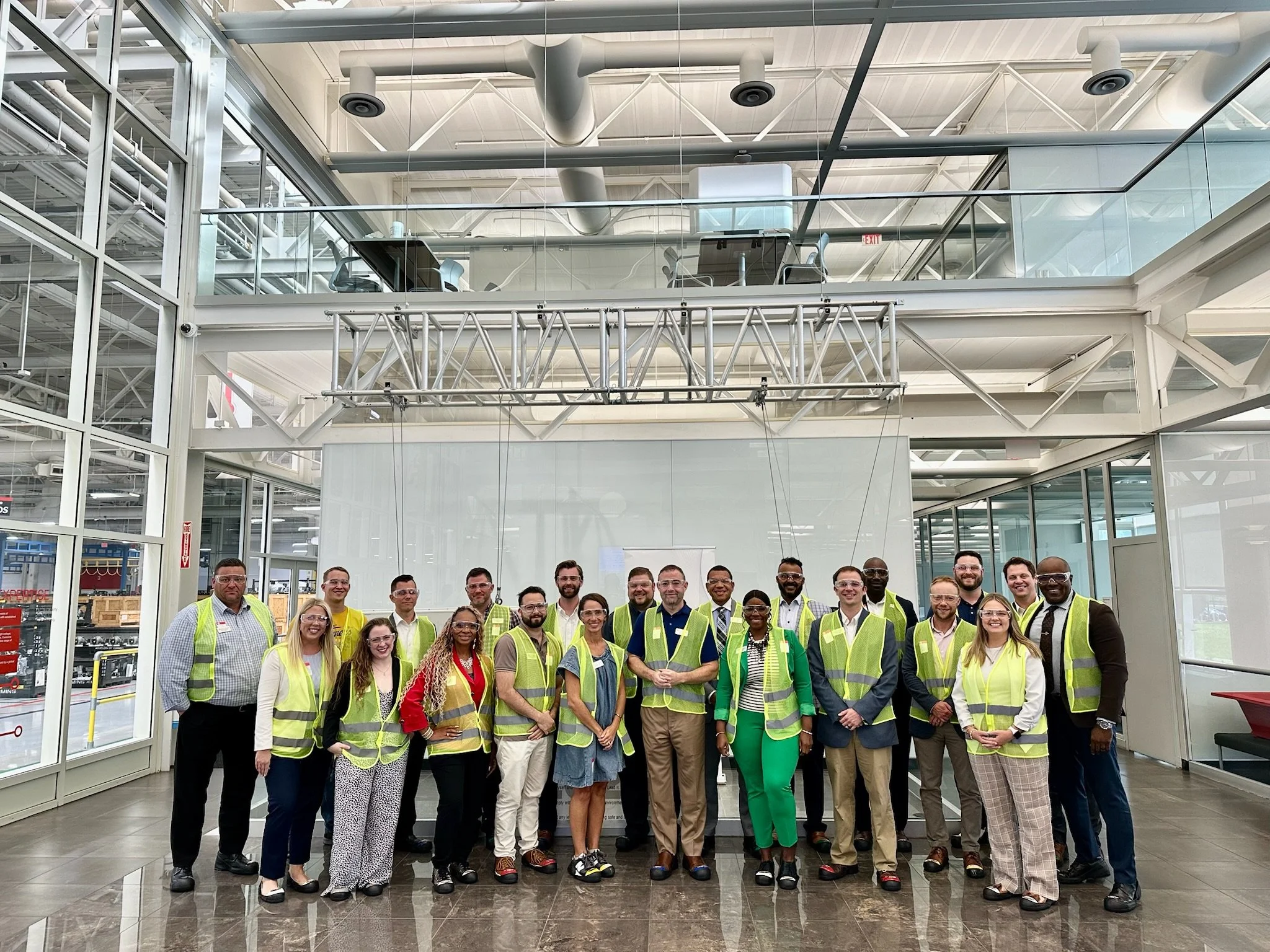
MDLF Class VIII Fellows at Cummins Engine Plant in Columbus, IN